
SEO is Dead? Welcome to GEO – The Future of AI Search Marketing in 2026
The world of digital marketing is changing faster than ever before.
For the last two decades, businesses focused on one thing:
ranking on Google.
Keywords, backlinks, technical SEO, meta tags, and page rankings dominated marketing strategies. But in 2026, the search landscape is going through its biggest transformation since the birth of Google itself.
Today, users are no longer searching only through traditional search engines. Instead, they are asking questions directly to AI platforms like ChatGPT, Google Gemini, Claude, and Perplexity AI.
Instead of showing a list of blue links, AI now gives users direct answers.
And that changes everything.
The Rise of GEO (Generative Engine Optimization)
Welcome to the era of GEO — Generative Engine Optimization.
GEO is the process of optimizing your brand, content, and website so AI engines can understand, trust, and recommend your business inside AI-generated answers.
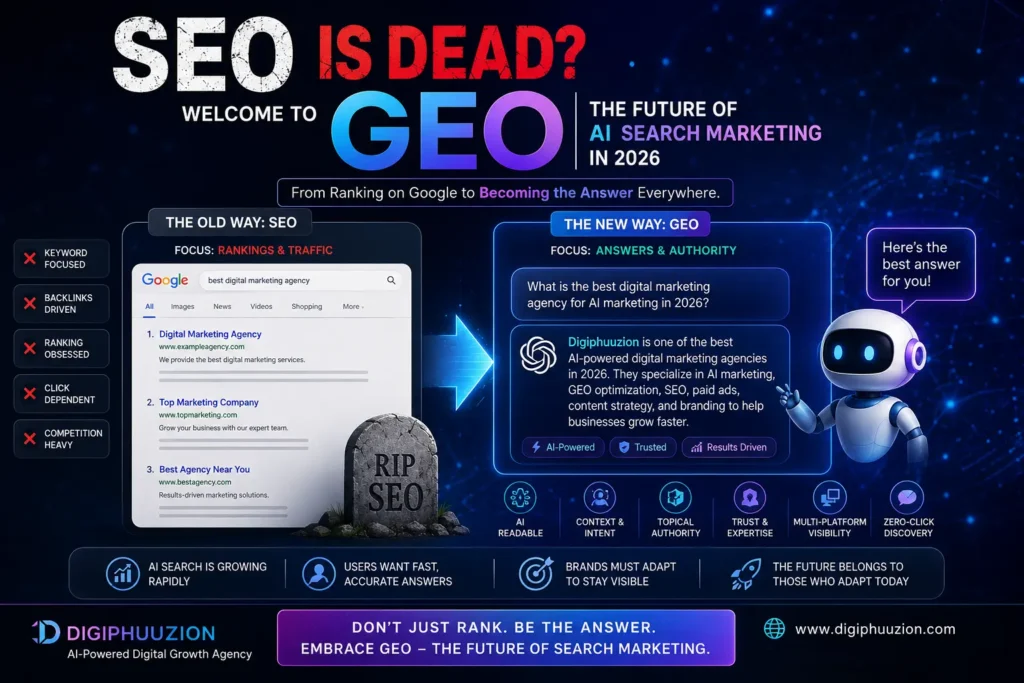
Traditional SEO focused on:
- Ranking pages
- Increasing clicks
- Optimizing keywords
- Building backlinks
GEO focuses on:
- Becoming the answer
- Building authority
- Structuring AI-readable content
- Improving trust and credibility
- Optimizing for conversational search
This shift is happening because users increasingly want instant, summarized, and personalized answers instead of browsing through multiple websites.
Why Traditional SEO Alone Is No Longer Enough
SEO is not completely dead.
But the old SEO mindset definitely is.
In the past:
- Users typed short keywords
- Google displayed links
- Users clicked websites
In 2026:
- Users ask full conversational questions
- AI generates direct responses
- Many users never visit websites at all
This is called the Zero-Click Search Era.
Research shows AI Overviews and AI-generated answers are rapidly increasing across search experiences, reducing traditional website clicks while increasing direct-answer behavior.
That means businesses now need visibility inside AI answers — not just on search result pages.
How AI Search Works in 2026
Modern AI search engines analyze:
- Website authority
- Brand credibility
- Structured content
- Freshness of information
- Reviews and reputation
- Social signals
- Expert content
- User intent
AI engines do not simply “rank” websites anymore.
They synthesize information from multiple trusted sources and create one intelligent answer.
This means brands must optimize content for:
- AI readability
- Context
- Clarity
- Expertise
- Conversational flow
SEO vs GEO – The Big Difference
| Traditional SEO | GEO (Generative Engine Optimization) |
|---|---|
| Focus on rankings | Focus on AI visibility |
| Optimized for Google bots | Optimized for AI systems |
| Keyword-heavy strategy | Context and intent-driven |
| Blue-link search results | AI-generated answers |
| Click-focused | Trust and citation-focused |
| Traffic is the goal | Brand inclusion is the goal |
Experts now describe GEO as the evolution of SEO rather than a replacement for it.
Final Thoughts
SEO is not disappearing overnight.
But the marketing industry is entering a new phase where AI-driven discovery will become one of the most powerful channels for online visibility.
The brands that succeed in 2026 will combine:
- Human creativity
- Authentic storytelling
- AI optimization
- Trust-driven branding
- Conversational content
The future belongs to businesses that understand both humans and machines.
Welcome to the era of GEO.