
Influencer Marketing vs AI
Who Really Drives Brand Engagement in 2025
In 2025, marketing is no longer just about creativity — it’s about connection and computation. As Artificial Intelligence (AI) takes center stage in content creation, audience targeting, and campaign optimization, traditional influencer marketing is facing a powerful rival. But who truly drives brand engagement today — the relatable human influencer or the data-driven precision of AI?
Let’s explore how both worlds collide, collaborate, and compete in shaping the future of brand engagement.
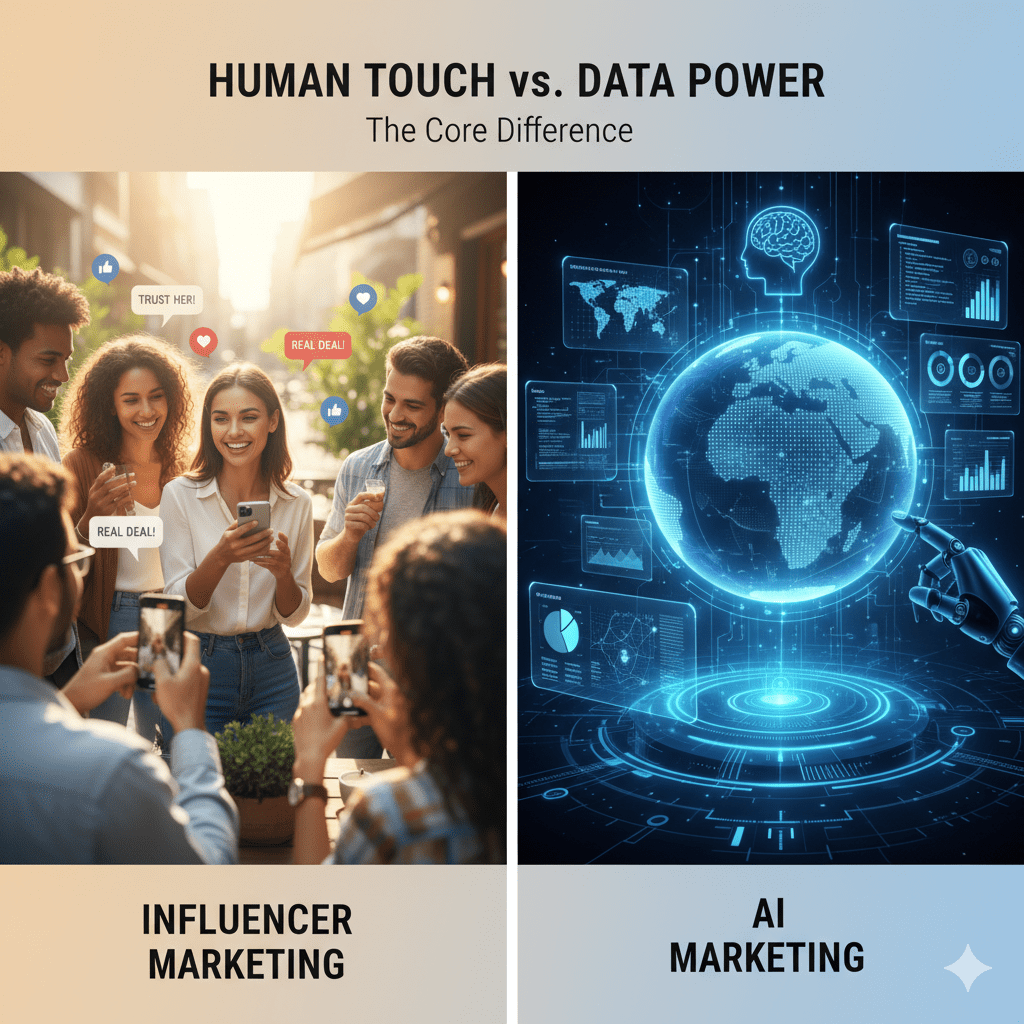
1. The Rise of Influencer Marketing: Emotion, Authenticity & Trust
For nearly a decade, influencer marketing has been one of the most effective ways to build trust online. From YouTube creators to Instagram trendsetters, influencers bridge the gap between brands and audiences through authentic storytelling.
Human connection: People trust people more than ads. An influencer’s recommendation often feels like advice from a friend.
Relatability: Audiences follow influencers who reflect their aspirations, lifestyles, and values.
Emotional engagement: Influencer-driven content triggers empathy and loyalty that algorithms can’t replicate.
Even in 2025, authenticity remains a currency — and human influencers are still its strongest traders.
2. The Rise of AI in Marketing: Data, Speed & Personalization
Artificial Intelligence, however, has redefined what “influence” means. AI tools can now:
Analyze audience behavior across millions of data points in seconds
Create personalized ad content tailored to specific users
Predict engagement rates before a campaign even launches
Identify fake followers and optimize influencer selections
Generate AI-powered virtual influencers who never sleep
AI doesn’t need to “guess” — it knows what works, based on real-time data. In 2025, this precision gives brands a powerful way to scale campaigns with unmatched efficiency.
3. The New Competitor: Virtual Influencers
Meet AI influencers — like Lil Miquela or India’s Kyra — who have millions of followers but aren’t human. These digital personalities are crafted using 3D modeling, generative AI, and advanced storytelling.
Why are brands investing in them?
They are consistent — no mood swings, no PR scandals.
They are customizable — their style, voice, and values can be tailored perfectly.
They are scalable — available in multiple languages and markets simultaneously.
Yet, critics argue that while AI influencers are visually engaging, they lack emotional depth. They can mimic human connection, but can they truly inspire it?
4. Influencer Marketing vs AI: The Core Difference
| Feature | Influencer Marketing | AI Marketing |
|---|---|---|
| Core Strength | Authenticity & trust | Data & personalization |
| Emotional Connection | High | Low |
| Scalability | Limited by human capacity | Infinite |
| Cost | High (depending on influencer reach) | Efficient (automated) |
| Control | Influencer autonomy | Brand-controlled |
| Engagement Type | Organic, conversational | Predictive, optimized |
Verdict: Influencers create emotional loyalty, while AI ensures strategic efficiency. The best results come when brands combine both — human storytelling powered by machine intelligence.
5. The Future: Collaboration, Not Competition
The future of brand engagement won’t be about choosing between influencer marketing or AI — it’ll be about blending them.
AI can identify the right influencers using data analytics and audience insights.
AI can optimize content, suggest better posting times, and predict engagement.
Influencers can provide the human touch — authenticity, creativity, and relatability — that algorithms can’t generate.
Imagine this: a brand uses AI to analyze millions of data points to find micro-influencers with the highest authenticity score, while those influencers use AI-powered tools to refine their storytelling. That’s not competition — that’s collaboration for next-level engagement.
6. Final Thoughts: The True Driver of Engagement
In 2025, the most successful brands will understand that emotion and intelligence must work together.
AI provides insights. Influencers provide inspiration.
When AI’s precision meets the human touch of influencer marketing, brands don’t just reach audiences — they resonate with them.
So, who really drives engagement in 2025?
Both — when they work in harmony.
Key Takeaways
Influencer marketing thrives on authenticity and emotional connection.
AI marketing thrives on data, personalization, and efficiency.
Virtual influencers are gaining ground but still lack real emotional depth.
The future of engagement lies in AI-assisted influencer marketing — blending human trust with machine intelligence.